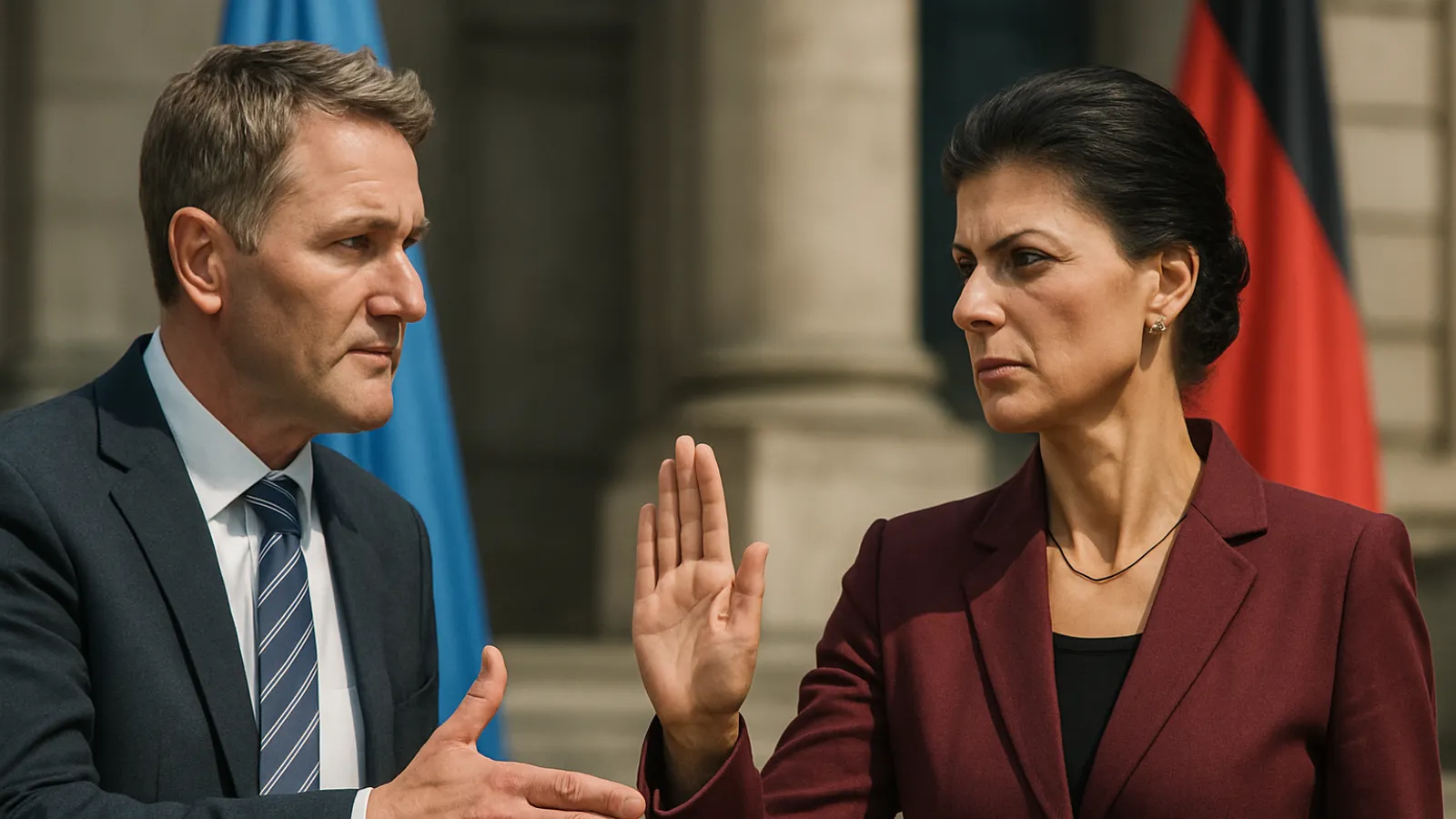
 AI-generated illustrative image · not a real photograph
Höcke’s controversial alliance offer to Wagenknecht — and what is behind it
Background & Context
Björn Höcke, the leader of the Alternative for Germany (AfD) in the eastern German state of Thuringia, publicly urged Sahra Wagenknecht to become the state’s minister-president, roughly the equivalent of a U.S. governor.
Wagenknecht founded the Alliance Sahra Wagenknecht (BSW), a populist party that combines left-wing economic positions with more restrictive views on migration and other issues. In a video, Höcke said the AfD and BSW could open a new political chapter together and told Wagenknecht, “I extend my hand to you.” In the Thuringian state parliament, the AfD holds 32 seats and BSW 15.
Together, they have 47 of 88 seats — enough for a numerical majority. Whether Höcke’s move amounted to a serious alliance proposal is a matter of political interpretation.
Wagenknecht has since rejected the proposal, calling it neither honest nor credible. BSW board member Klaus Ernst also described it as a PR stunt.
The phrase “controversial alliance offer” therefore refers to a real political move, but its seriousness and strategic purpose cannot be established as simple facts.
Article Profile

Dramatization
Pronounced
7/10
The article emphasizes events emotionally and relies on distinctly dramatizing language.
Moralizing
Moderate
5/10
Some passages carry evaluative or moral undertones.
Sharpening
Moderate
6/10
The article sharpens individual aspects but keeps some nuance.
Objectivity
Medium
4/10
The article mixes factual information with evaluative elements.
Review Transparency
We reviewed Höcke’s specific statement, the balance of seats in the Thuringian state parliament, and Wagenknecht’s subsequent response. Whether the offer was politically “controversial” or primarily tactical is an editorial assessment rather than a verifiable fact.
The headline should therefore be understood as analysis and framing around a documented political proposal, not as a simple factual claim.
Impact Check
Does it affect you?
60% impact
Voters in Thuringia and Saxony-Anhalt could be affected by new political alliances, as such coalitions can shift the balance of power.
Security risk?
10% impact
No direct security risk for Germany, as there are currently no concrete threats arising from the political development.
Historic?
75% impact
Political alliances between ideologically opposed parties are rare, but not without historical precedents in times of crisis.
Why is this article's headline most likely opinion piece
Höcke’s move is documented: he offered AfD support for Wagenknecht to become minister-president of Thuringia. Whether this was a serious alliance proposal or primarily a tactical political move cannot be established as fact; Wagenknecht has rejected the offer as not credible.
The key additional context is that the numbers do work: the AfD and BSW together control 47 of the state parliament’s 88 seats, but there is currently no political agreement between them to form a governing majority.
This analysis is based on a journalistic report by merkur.de. The rating and context were produced with AI assistance.
AI Transparency
This analysis was produced, structured and editorially reviewed with AI-assisted systems. The rating refers to the specific statement examined and is based on the sources cited. The cover image is an AI-generated symbolic image and is not a documentary photograph of the event described.
Methodology & AI Transparency