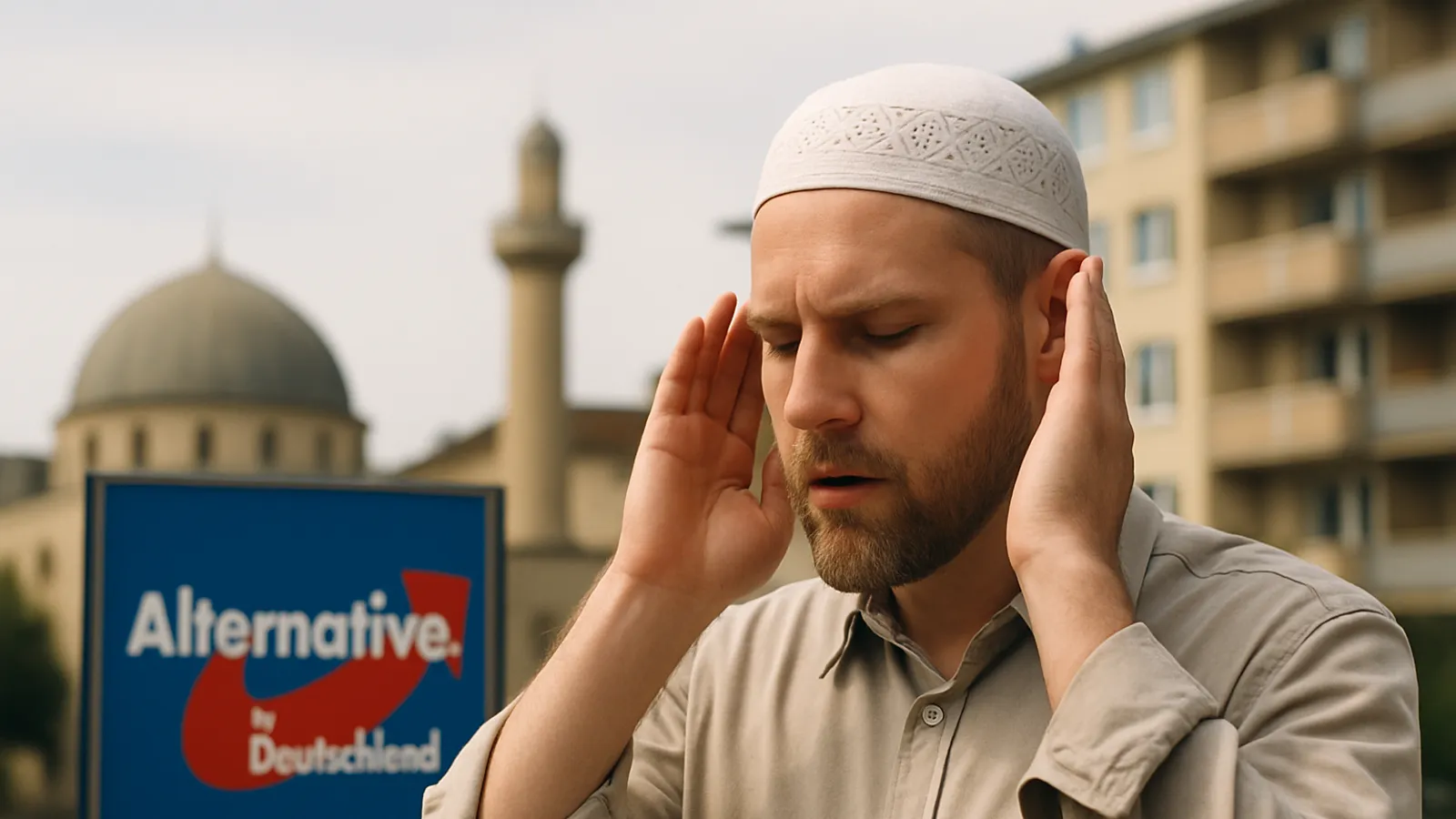
 AI-generated illustrative image · not a real photograph
AfD member converts to Islam – Arthur, Ahmad and the Alternative
Background & Context
Arthur Wagner, then an AfD party official in Havelland, a district in the eastern German state of Brandenburg, converted to Islam on October 29, 2017. The case drew nationwide attention in early 2018.
Wagner resigned from his party posts but explicitly said he wanted to remain an AfD member. Contemporary reports do not document an expulsion over his conversion; the AfD leadership in Brandenburg cited freedom of religion.
Whether Wagner still belongs to the AfD today cannot be reliably determined from currently available public sources. The apparent contradiction between being Muslim and belonging to the AfD is also more nuanced than the debate at the time suggested: the AfD rejects Islam as a defining force in German society or politics, while explicitly recognizing freedom of religion and describing integrated, law-abiding Muslims as part of Germany.
Wagner himself remained a national conservative and continued to support numerous AfD positions, but he disagreed with his party on Islam and wanted to act as a bridge between Muslims and national conservatives.
Article Profile

Dramatization
Low
3/10
The article covers the topic largely soberly, without dramatic exaggeration.
Moralizing
Low
2/10
The presentation largely avoids moral judgments.
Sharpening
Low
3/10
The article is nuanced and avoids confrontational sharpening.
Objectivity
High
7/10
The article is largely factual and fact-oriented.
Review Transparency
We reviewed contemporaneous reports on Arthur Wagner’s conversion to Islam, his resignation from party offices, and his stated intent to remain an AfD member. Multiple media outlets reported on the case independently in 2018.
From currently available public sources, it cannot be definitively determined whether Wagner still belongs to the AfD today. Nor can this individual case be used to infer that the AfD has changed its fundamental position on Islam.
The party leadership at the time differentiated between Wagner’s individual freedom of religion and the party’s political stance on Islam. The headline accurately describes the historical event but does not reflect later developments and nuances.
Impact Check
Does it affect you?
35% impact
The case primarily concerns the AfD’s internal debate over freedom of religion versus party platform and could influence public perceptions of the party.
Security risk?
5% impact
No security risk, as this involves a personal faith decision by a local official.
Historic?
65% impact
Religious conversions by politicians are historically rare and regularly spark debates about credibility and consistency with party positions.
Why is this article's headline most likely true
The sequence of events is clearly documented: Arthur Wagner converted to Islam in 2017 and, by his own account, initially remained an AfD member even after giving up his party offices. His conversion caused significant tensions with parts of the party but did not automatically result in his expulsion.
The situation is less contradictory than it may appear at first: the AfD rejects Islam as a defining force in German society or politics, while also affirming individual freedom of religion and, according to its platform, accepting law-abiding, integrated Muslims as part of German society. Wagner combined his new faith with national-conservative positions but clearly diverged from the party line on Islam.
Whether he is still an AfD member today cannot be reliably determined from public sources.
This analysis is based on a journalistic report by deutschlandfunk.de. The rating and context were produced with AI assistance.
AI Transparency
This analysis was produced, structured and editorially reviewed with AI-assisted systems. The rating refers to the specific statement examined and is based on the sources cited. The cover image is an AI-generated symbolic image and is not a documentary photograph of the event described.
Methodology & AI Transparency