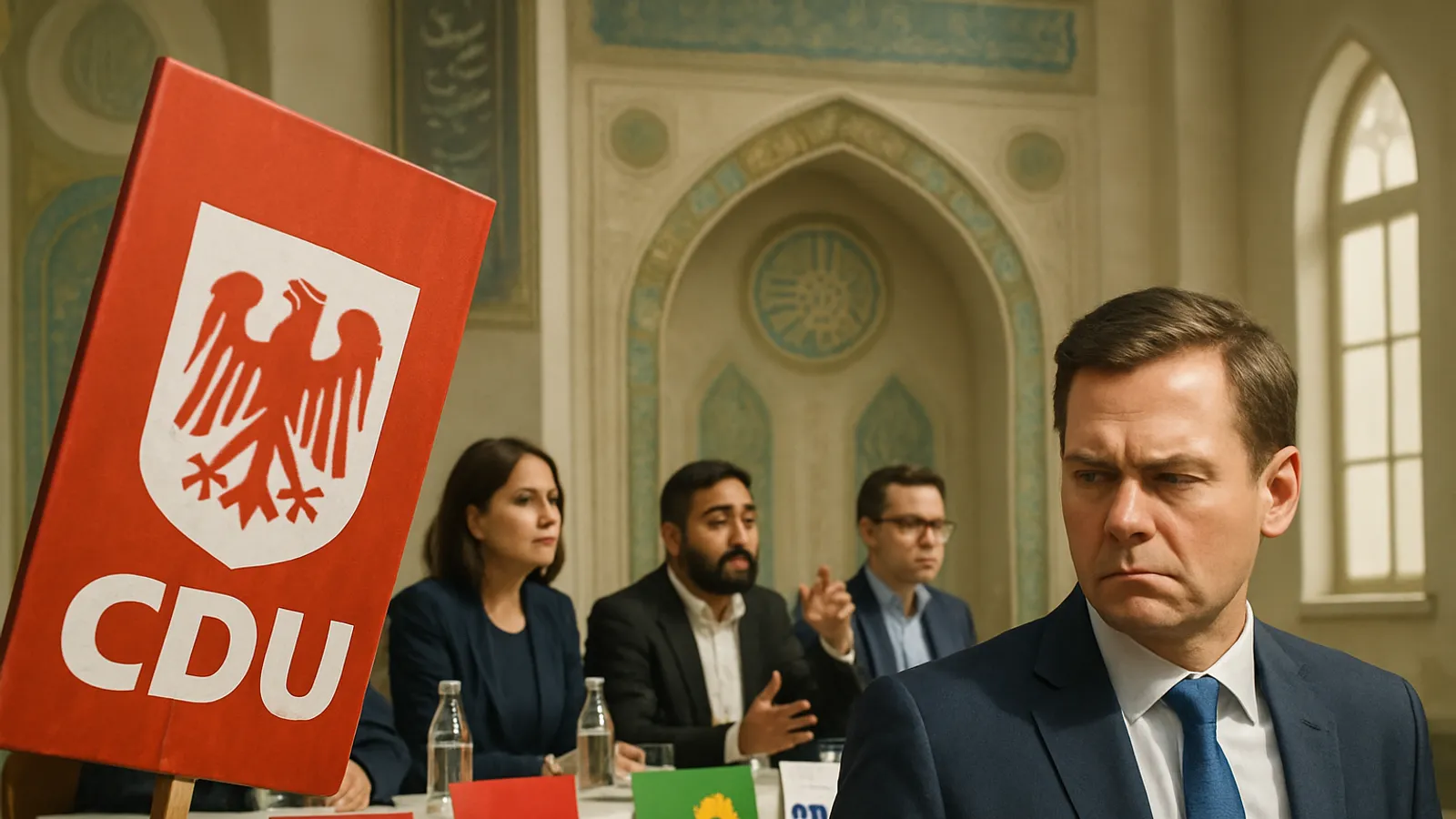
 AI-generated illustrative image · not a real photograph
Berlin CDU boycotts mosque election forum: “The Left, SPD, Greens and FDP are campaigning with Islamists”
Background & Context
The Berlin branch of the CDU, Germany’s center-right Christian Democratic party, is not taking part in an election forum organized by the “Council of Berlin Imams” at the Neuköllner Begegnungsstätte (NBS), a mosque and community center in Berlin’s Neukölln district. Christopher Förster, a CDU lawmaker from Neukölln, cited possible ties of some participants to legalistic Islamism and told FOCUS online verbatim: “The SPD, The Left and the Greens are campaigning here with Islamists.” He did not name the FDP in this direct quote; the party was added to the quoted statement in the headline.
The CDU’s concerns are not baseless, but the background is more nuanced than the term “Islamists” suggests. The NBS was previously mentioned in reports by Berlin’s domestic intelligence service, the Verfassungsschutz, in connection with the Muslim Brotherhood.
In 2018, however, the Berlin-Brandenburg Higher Administrative Court ruled that its portrayal in the report at the time was unlawful or misleading; the NBS has not been named there since. The court expressly did not rule out further monitoring.
As for the “Council of Berlin Imams,” individual members or affiliated institutions have in the past been linked by domestic intelligence agencies or the federal government to Muslim Brotherhood–adjacent or Islamist networks. That does not automatically mean the entire council or all participants in the election forum can be classified as Islamists.
Politically, the dividing line is also less clear-cut than CDU on one side and SPD or Greens on the other. SPD lead candidate Steffen Krach calls the CDU’s nonparticipation “irresponsible,” while Green lead candidate Bettina Jarasch defends dialogue with Muslim actors as part of a credible fight against Islamism.
At the same time, there are considerably more cautious voices within both parties: Neukölln’s SPD district mayor Martin Hikel said he had always been cautious about such invitations. Green Bundestag member and Islamism expert Lamya Kaddor had previously said she deliberately declined invitations from the NBS because actors associated with legalistic Islamism could use political proximity for their own purposes.
The dispute is therefore not simply about “dialogue versus exclusion,” but also about when political presence may confer additional legitimacy on problematic actors.
Article Profile

Dramatization
Moderate
6/10
The article uses occasional dramatizing wording but stays mostly factual.
Moralizing
Moderate
4/10
Some passages carry evaluative or moral undertones.
Sharpening
Moderate
6/10
The article sharpens individual aspects but keeps some nuance.
Objectivity
Medium
5/10
The article mixes factual information with evaluative elements.
Review Transparency
We reviewed the full FOCUS online report, the earlier mention of the Neuköllner Begegnungsstätte in Berlin’s domestic intelligence report, the decision of the Berlin-Brandenburg Higher Administrative Court, and documented political reactions to the election forum. What matters is separating contacts from a clear-cut classification: The court found the NBS’s portrayal in the domestic intelligence report at the time to be unlawful or misleading; this did not preclude further monitoring.
At the “Council of Berlin Imams,” connections by individual members to organizations that in the past were classified as Muslim Brotherhood–adjacent or Islamist are also documented. Political actors’ language is strongly value-laden.
Förster speaks of “Islamists,” “naive and dangerous,” and of not elevating such actors. On the other side, SPD lead candidate Steffen Krach calls the CDU’s nonparticipation “irresponsible,” while FDP representatives accuse the CDU of staying away out of fear of direct confrontation.
Such formulations morally judge the other side’s strategy but do not clarify the actual classification of every imam or association involved. In addition, even SPD and Green politicians such as Martin Hikel and Lamya Kaddor have warned against uncritical political proximity to this milieu.
The debate therefore cannot be neatly divided into “democratic dialogue” on one side and “overblown fears of Islamism” on the other.
Impact Check
Does it affect you?
60% impact
Berlin voters are affected because the CDU rejects and criticizes campaigning in the mosque.
Security risk?
10% impact
No direct security risk for Germany, as this is a local political event.
Historic?
75% impact
Recurring, as political parties often avoid Islamic institutions during campaigns.
Why is this article's headline most likely mostly true
The claim is largely true: The CDU is boycotting the election forum, and Christopher Förster did in fact say that the SPD, The Left and the Greens were “campaigning with Islamists” there. The headline, however, alters his direct quote by additionally inserting the FDP.
Moreover, “with Islamists” is Förster’s political assessment, not an official classification of all organizers. There is, however, a real backdrop to concerns about politically elevating problematic actors: Individual people and institutions around the “Council of Berlin Imams” have in the past been linked to Muslim Brotherhood–adjacent or Islamist networks.
At the same time, a court criticized the earlier blanket portrayal of the Neuköllner Begegnungsstätte in the domestic intelligence report. The conflict is therefore real, but the headline compresses the attribution more tightly than the facts allow.
This analysis is based on a journalistic report by focus.de. The rating and context were produced with AI assistance.
AI Transparency
This analysis was produced, structured and editorially reviewed with AI-assisted systems. The rating refers to the specific statement examined and is based on the sources cited. The cover image is an AI-generated symbolic image and is not a documentary photograph of the event described.
Methodology & AI Transparency