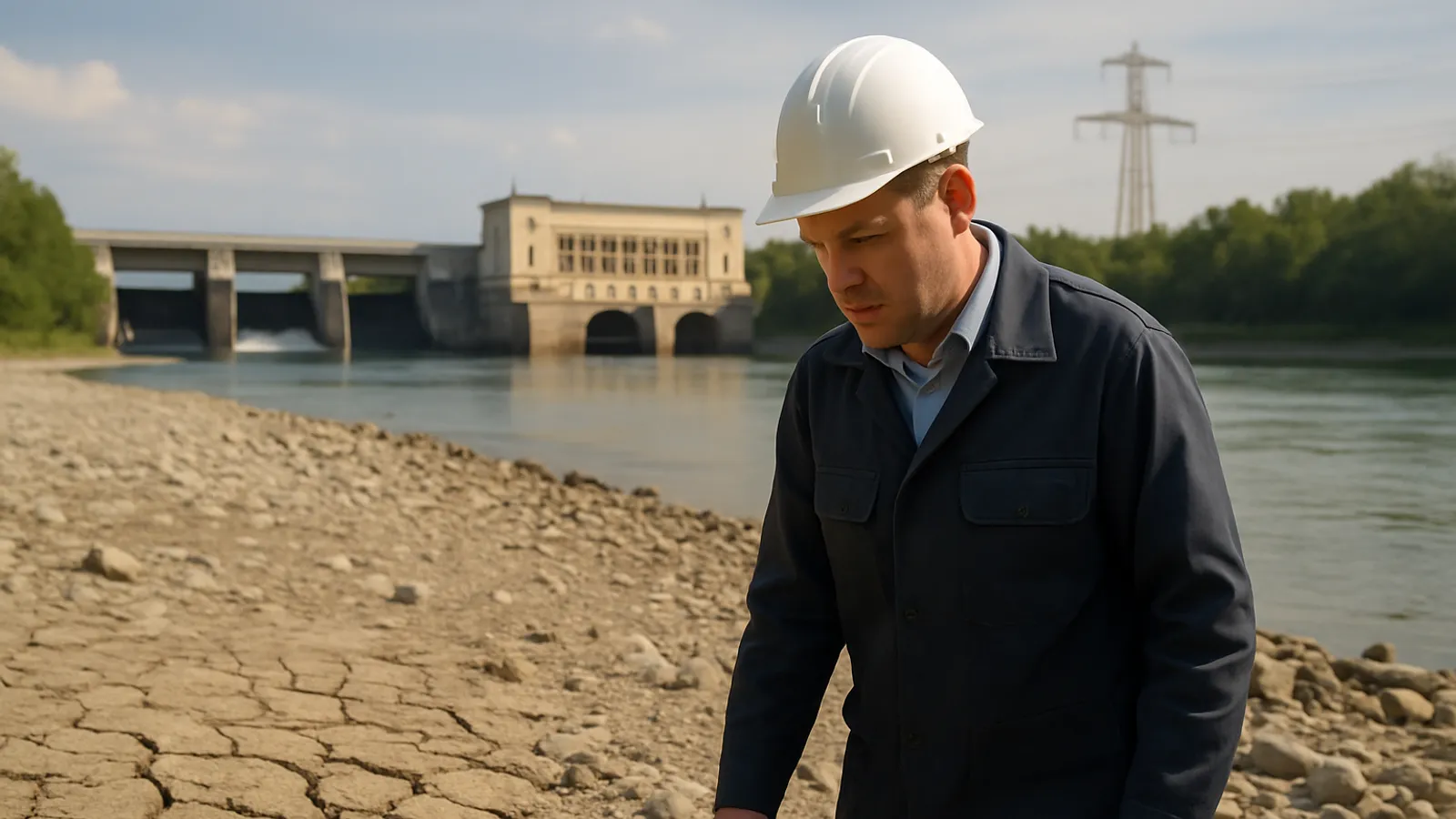
 AI-generated illustrative image · not a real photograph
Water shortages on the Danube threaten power generation in Central Europe.
Background & Context
The Danube is Europe’s second-longest river and a major waterway running through Central and Southeastern Europe. Several power plants along the river depend on its water either to generate hydropower or to cool nuclear reactors.
The Danube’s low water level is causing significant restrictions on power generation in Central Europe. In Romania, Hungary, and Austria, hydroelectric and nuclear power plants have had to cut output or temporarily shut down.
Affected facilities include the Cernavodă nuclear power plant in Romania, the Paks nuclear power plant in Hungary, and numerous hydropower stations in Austria. An acute threat to the public electricity supply has not been substantiated so far.
Possible effects on electricity prices also cannot be attributed to water shortages alone. Energy prices are also influenced by geopolitical conflicts, fuel prices, political decisions, grid costs, and the structure of the electricity market.
The low water level therefore adds pressure to an energy system already affected by other factors.
Article Profile

Dramatization
Pronounced
8/10
The article emphasizes events emotionally and relies on distinctly dramatizing language.
Moralizing
Low
3/10
The presentation largely avoids moral judgments.
Sharpening
Moderate
5/10
The article sharpens individual aspects but keeps some nuance.
Objectivity
Medium
4/10
The article mixes factual information with evaluative elements.
Review Transparency
The impacts of low Danube levels on power plants in Romania, Hungary, and Austria were examined. Output reductions and temporary shutdowns are documented.
The causes of low water levels are cited in particular as a lack of precipitation and less meltwater.
It is not substantiated that water shortages alone lead to rising electricity prices or supply problems. Geopolitical developments, energy policy decisions, fuel and grid costs, and the respective composition of power generation are also relevant.
The fundamental vulnerability of water-dependent power plants during droughts was moreover foreseeable beforehand.
Impact Check
Does it affect you?
60% impact
Power plants in Central Europe are reducing output because water shortages are making cooling more difficult.
Security risk?
10% impact
No direct safety risk for Germany, as the energy supply is not endangered.
Historic?
75% impact
Drought and low water levels are historical challenges for the Danube region.
Why is this article's headline most likely true
The claim is substantiated: Low water levels on the Danube are reducing power generation in parts of Central Europe. Hydroelectric and nuclear power plants in Romania, Hungary, and Austria have cut output or temporarily shut down.
This analysis is based on a journalistic report by zeit.de. The rating and context were produced with AI assistance.
AI Transparency
This analysis was produced, structured and editorially reviewed with AI-assisted systems. The rating refers to the specific statement examined and is based on the sources cited. The cover image is an AI-generated symbolic image and is not a documentary photograph of the event described.
Methodology & AI Transparency