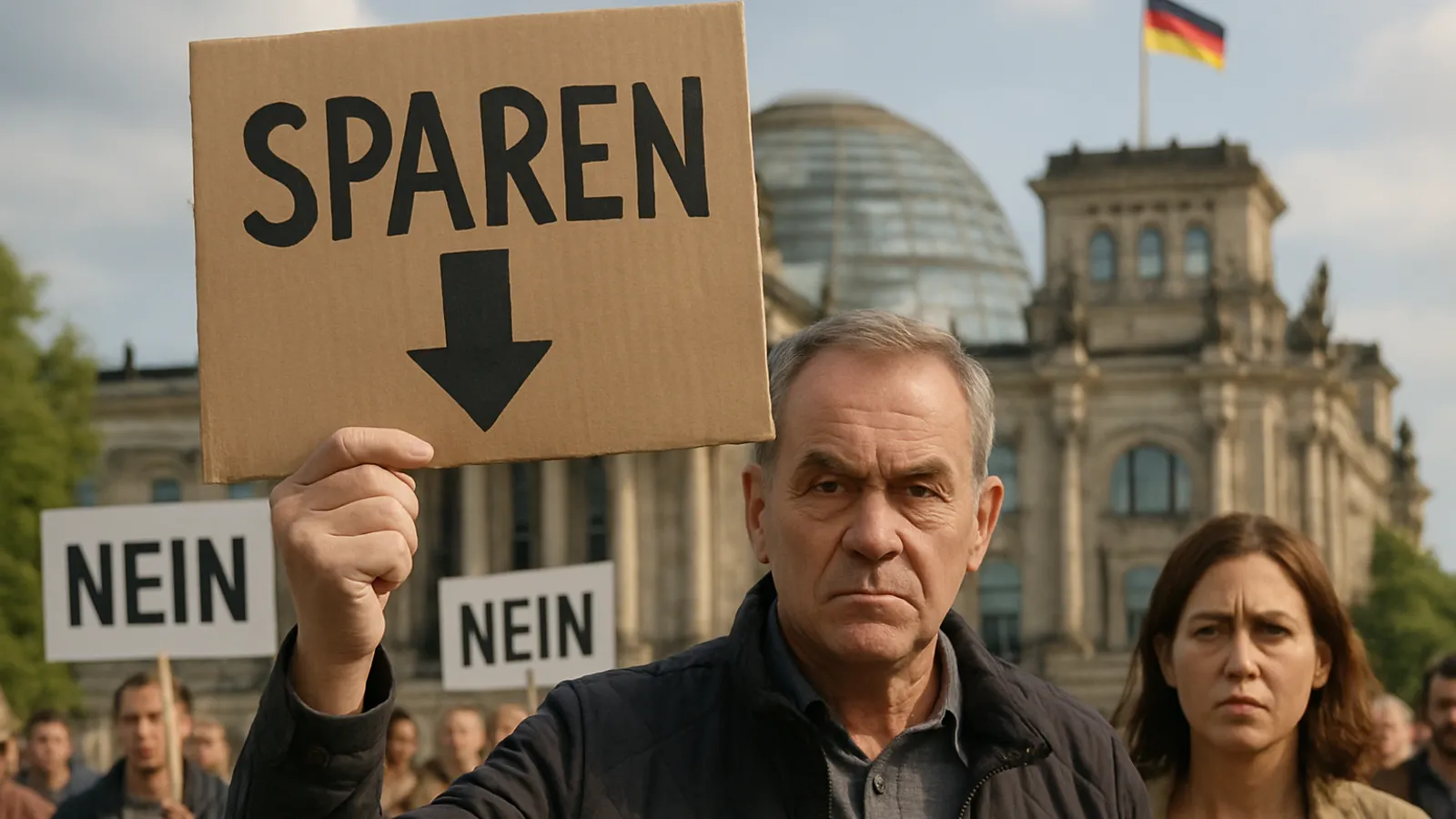
 AI-generated illustrative image · not a real photograph
Welfare state: An austerity drive against voters’ will — can it work?
Background & Context
This guest commentary addresses a real debate about financing Germany’s welfare state. The starting point is the 2026 “Sozialstaatsradar” by the DGB, the German Trade Union Confederation, which surveyed a total of 3,000 people.
The results show strong basic support for social protection: Around three-quarters of employed respondents would be willing to accept higher pension contributions if that stabilizes pension levels or improves benefits. 62% accept somewhat higher contributions for a stable pension level, while another 12% would accept significantly higher contributions for better benefits.
However, this cannot simply be read as a general “voters’ will” against spending cuts. Support for higher contributions is conditional, and the survey does not require participants to fully weigh social spending against disposable income and other public spending such as defense, infrastructure, education, or climate policy.
Being willing to pay “somewhat higher” contributions is also not the same as accepting whatever contribution level may eventually be required. This is precisely where the piece comes in.
The German Council of Economic Experts projects that, if current law remains unchanged, the overall social insurance contribution rate will rise from 42.3% in 2026 to 45.4% in 2030 and to 49.7% in 2040. The council warns that higher contribution rates would reduce households’ net incomes while increasing labor costs for businesses.
The political question, therefore, is not simply whether people want a strong welfare state — there is clear evidence that many do. The open question is how much additional financial burden they would actually accept once concrete contribution levels and competing political priorities are taken into account.
The headline’s phrase “against voters’ will” compresses this more complex situation into a pointed political premise.
Article Profile

Dramatization
Low
2/10
The article covers the topic largely soberly, without dramatic exaggeration.
Moralizing
Moderate
4/10
Some passages carry evaluative or moral undertones.
Sharpening
Moderate
6/10
The article sharpens individual aspects but keeps some nuance.
Objectivity
Medium
5/10
The article mixes factual information with evaluative elements.
Review Transparency
We reviewed the statements underlying the piece from the DGB’s 2026 Sozialstaatsradar and the current projections by the German Council of Economic Experts. The DGB survey of a total of 3,000 people documents strong support for solidarity-based social insurance systems.
Among employees, there is also clear willingness to accept higher contributions for stable or better pension benefits. However, these findings do not prove a blanket “voters’ will” against all cuts or reforms.
For one thing, some results pertain to employees rather than a vote of all eligible voters. For another, the answers are conditional and do not reflect a complete decision among social benefits, contribution levels, and other public expenditures.
At the same time, the pressure for financial reform is independently documented. If the legal framework remains unchanged, the council expects the overall social insurance contribution rate to rise from 42.3% in 2026 to 49.7% in 2040, warning of burdens on net incomes, employment, and economic growth.
The terms “austerity course” and especially “against voters’ will” are therefore political compressions. While the headline’s question format signals openness, its underlying assumption of a clearly fixed voters’ will goes further than the available survey data support.
Impact Check
Does it affect you?
60% impact
Political decisions could affect the welfare state, as reforms are being planned.
Security risk?
10% impact
No direct security risk, as this concerns internal political discussions.
Historic?
75% impact
Comparable reform debates have accompanied earlier discussions about the welfare state as well.
Why is this article's headline most likely an analysis
The headline is best understood as an analytical question. It is well documented that large parts of the population support a strong welfare state and that many employees would, under certain conditions, accept higher contributions.
What is not established is a uniform “voters’ will” that is categorically opposed to cuts or reforms. The survey measures support for specific social-policy benefits and a conditional willingness to pay higher contributions.
It does not show how respondents would decide if concrete contribution increases, lower net income, and competing public spending priorities were presented at the same time. The piece therefore highlights an important distinction: Wanting a strong welfare state does not automatically mean accepting every financial burden required to fund it.
Whether an austerity drive can ultimately “work” remains a political and societal question, not a claim that can simply be rated true or false.
This analysis is based on a journalistic report by zeit.de. The rating and context were produced with AI assistance.
AI Transparency
This analysis was produced, structured and editorially reviewed with AI-assisted systems. The rating refers to the specific statement examined and is based on the sources cited. The cover image is an AI-generated symbolic image and is not a documentary photograph of the event described.
Methodology & AI Transparency