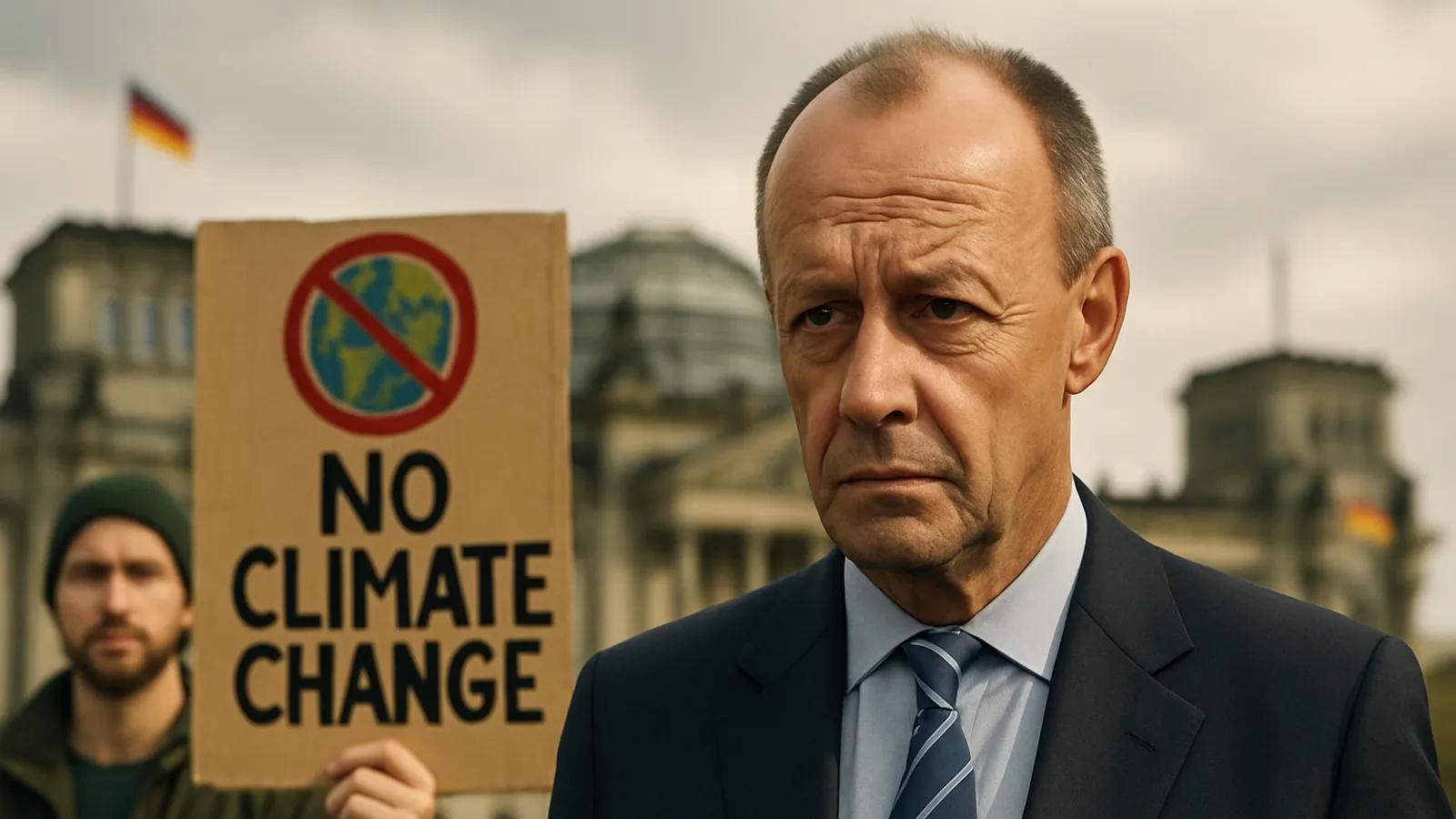
 AI-generated illustrative image · not a real photograph
Merz and climate-change deniers: Are we getting a “climate chancellor” now?
Background & Context
The headline is a political analysis question, not a statement of fact. The backdrop is German Chancellor Friedrich Merz’s appearance after severe forest fires and a heat wave.
After returning from vacation, he visited a fire-affected area and criticized people who deny human-caused climate change. Der Spiegel, a German news magazine, turns this into the broader question of whether Merz could begin positioning himself more strongly on climate policy.
Whether this marks a lasting shift remains open. What would matter are concrete government decisions on heat protection, emissions reduction and other areas of climate policy.
“Climate chancellor” is therefore a journalistic role label and a question about the future—not a status that can currently be rated true or false.
Article Profile

Dramatization
Moderate
6/10
The article uses occasional dramatizing wording but stays mostly factual.
Moralizing
Moderate
6/10
Some passages carry evaluative or moral undertones.
Sharpening
Pronounced
7/10
The article frames the topic in a strongly sharpened, confrontational way.
Objectivity
Medium
4/10
The article mixes factual information with evaluative elements.
Review Transparency
We reviewed the verifiable facts behind the question-form headline. Merz’s visit to the fire-affected area and his criticism of climate-change deniers are documented.
The label “climate chancellor” is not treated as a fact because it poses an open question about his future political role. It is also not established that his change in tone will lead to a lasting shift in climate policy or specific government measures.
Impact Check
Does it affect you?
60% impact
Public perception of Merz could change, since climate policy is currently a heavily debated issue in Germany.
Security risk?
10% impact
No direct security risk for Germany, as the debate is primarily political.
Historic?
75% impact
Political debates over climate policy and chancellor roles are historically common and shape the party landscape.
Why is this article's headline most likely a contextualization
The headline should be treated as analysis or context. It is documented that Merz criticized climate-change deniers after the forest fires and publicly addressed climate policy.
Whether he actually develops into a “climate chancellor” cannot yet be determined. That would require a longer-term change in political priorities and concrete government measures.
Der Spiegel’s question is therefore a pointed interpretation of Merz’s current positioning, not an unsupported factual claim.
This analysis is based on a journalistic report by spiegel.de. The rating and context were produced with AI assistance.
AI Transparency
This analysis was produced, structured and editorially reviewed with AI-assisted systems. The rating refers to the specific statement examined and is based on the sources cited. The cover image is an AI-generated symbolic image and is not a documentary photograph of the event described.
Methodology & AI Transparency