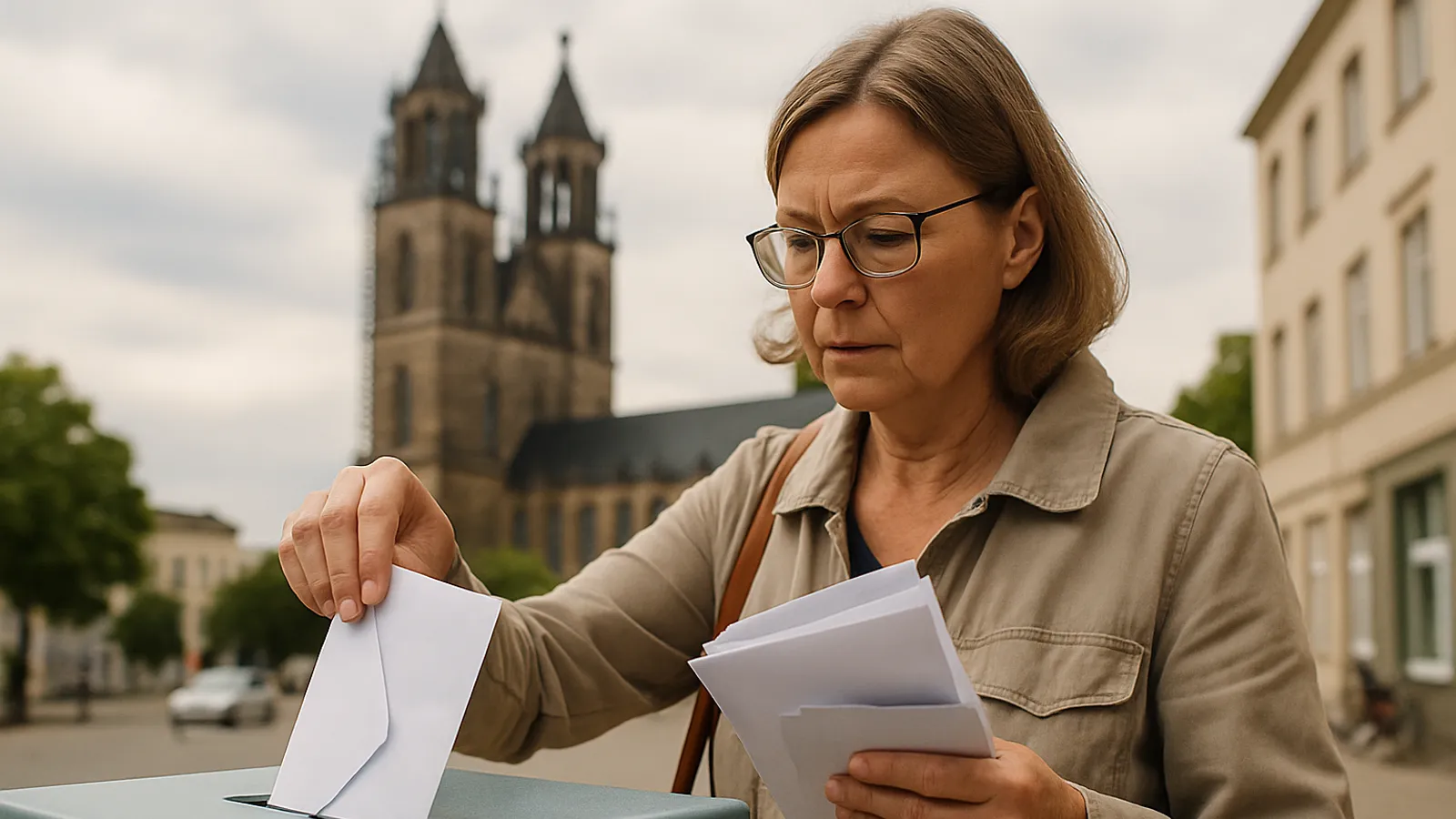
 AI-generated illustrative image · not a real photograph
Mail-in voting in Saxony-Anhalt: Cities report sharp increase
Background & Context
In Saxony-Anhalt, a German state, roughly 87,500 people in Magdeburg and Halle have already applied to vote by mail shortly before the state election. As of Monday, Magdeburg had about 48,300 applications, and Halle around 39,200.
For Halle, the article cites roughly 36,800 mail-in votes actually cast in the 2021 state election as a comparison. That points to an increase; how strong it is statewide, however, cannot be determined conclusively from these two cities alone.
In parallel, Alternative for Germany (AfD), a right-wing party, is expressing doubts about the security of mail-in voting and warns in particular about possible influence in nursing homes. There is no verifiable evidence so far for these current allegations; the state election authority and BIVA, a German advocacy group for nursing-home residents and people in need of care, reject them and point to legal and organizational safeguards.
The broader question of risks in mail-in voting is not irrelevant, though: Germany’s Federal Constitutional Court deems mail-in voting constitutional but notes that there is less public oversight than with in-person voting. There have also been documented manipulation cases, including in Stendal in 2014 and in the 2024 state election in Saxony.
These cases demonstrate the basic possibility of abuse, but they do not substantiate the current nursing-home allegations in Saxony-Anhalt.
Article Profile

Dramatization
Moderate
4/10
The article uses occasional dramatizing wording but stays mostly factual.
Moralizing
Low
3/10
The presentation largely avoids moral judgments.
Sharpening
Moderate
4/10
The article sharpens individual aspects but keeps some nuance.
Objectivity
High
8/10
The article is largely factual and fact-oriented.
Review Transparency
We checked the reported mail-in voting figures for Magdeburg and Halle as well as the security debate presented in the article. The roughly 87,500 applications are documented.
It should be noted, however, that the only specific historical comparison given concerns Halle and juxtaposes current applications with mail-in votes actually cast in 2021. The term “sharp increase” is therefore a journalistic sharpening.
In the security debate, a distinction must be made between current allegations and general risks. There is no concrete proof so far for the present claims of manipulation in nursing homes.
At the same time, mail-in voting manipulations in Germany are historically documented, including in Stendal in 2014 and in Saxony in 2024. The existence of such cases does not prove a systematic insecurity of mail-in voting and does not substantiate the current AfD allegations.
Impact Check
Does it affect you?
60% impact
Mail-in voting affects many voters in Saxony-Anhalt because it is being used more frequently and influences the election process.
Security risk?
10% impact
No risk to the security of mail-in voting in Germany, as it is protected by legal mechanisms.
Historic?
75% impact
Use of mail-in voting has increased in recent years, reflecting a long-term trend.
Why is this article's headline most likely mostly true
The claim is mostly true: Magdeburg and Halle together already have around 87,500 mail-in ballot applications, and for Halle an increase over the 2021 state election is apparent. The phrase “sharp increase,” however, is only partially substantiated, because there is no earlier comparison cited for Magdeburg and, for Halle, current applications are being compared with mail-in votes actually cast in 2021.
Nor can a definitive statewide trend be inferred yet from the two largest cities alone.
This analysis is based on a journalistic report by fr.de. The rating and context were produced with AI assistance.
AI Transparency
This analysis was produced, structured and editorially reviewed with AI-assisted systems. The rating refers to the specific statement examined and is based on the sources cited. The cover image is an AI-generated symbolic image and is not a documentary photograph of the event described.
Methodology & AI Transparency