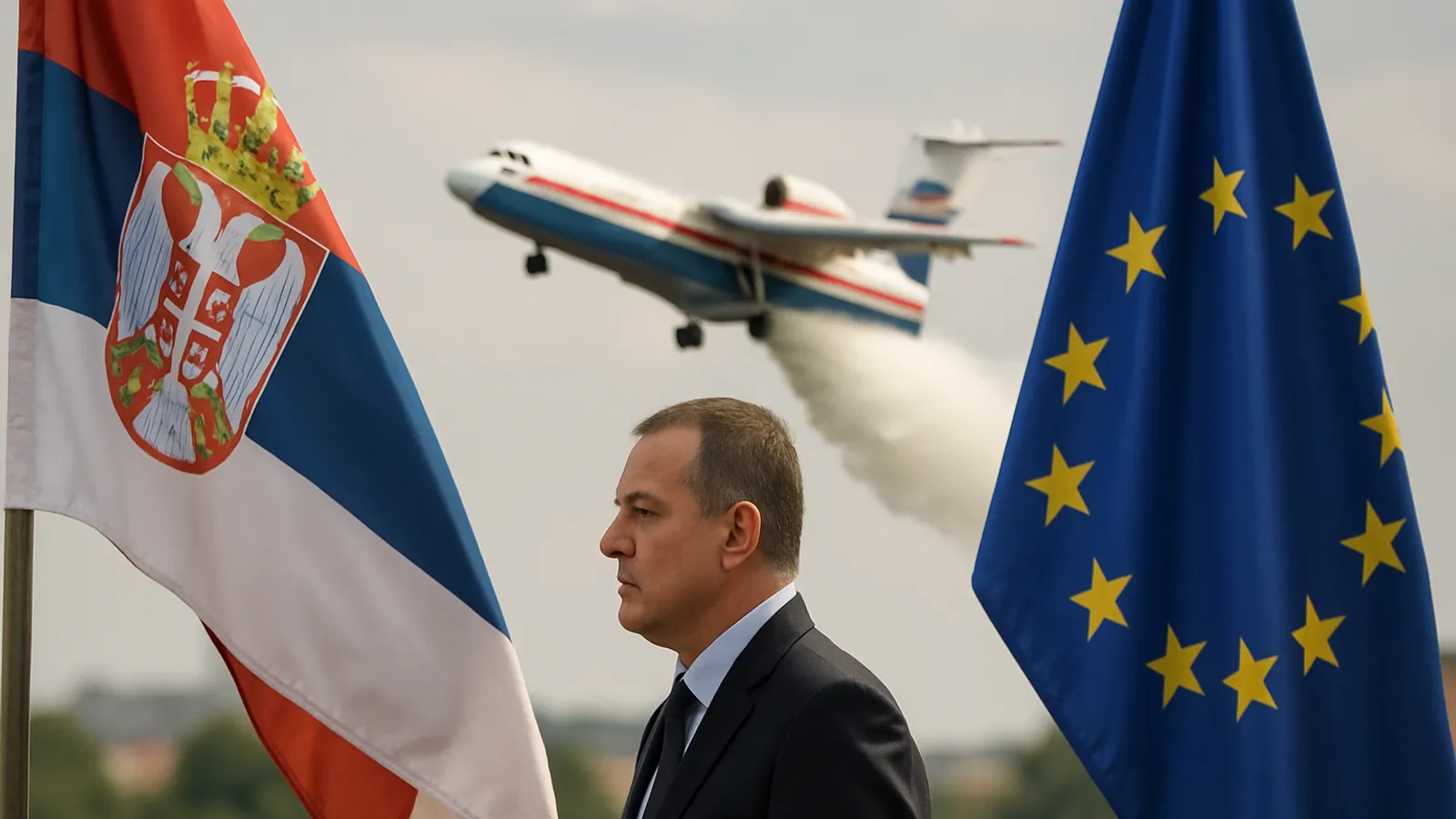
 AI-generated illustrative image · not a real photograph
Serbia rejects EU aid — and brings in a Russian water bomber
Background & Context
During severe wildfires in Serbia, a Russian Il-76 firefighting aircraft was deployed at Belgrade’s request. What is less clear is how Serbia handled European Union assistance beforehand.
The Frankfurter Rundschau, a German newspaper, reports that Serbian President Aleksandar Vučić initially declined firefighting assistance offered by both Russia and the EU as “not necessary,” then requested the Russian aircraft several days later. Other reports describe the sequence differently, saying Serbia had sought EU emergency assistance but that no firefighting aircraft with comparable capacity was available.
What is documented is that Serbia had not initially activated the EU Civil Protection Mechanism for the fires, while other EU support, including Copernicus satellite imagery, was already available. Serbia later activated the mechanism, and firefighting helicopters and crews from several EU countries subsequently arrived.
The headline therefore reduces a more complicated sequence to a clear-cut choice against the EU and in favor of Russia.
Article Profile

Dramatization
Moderate
6/10
The article uses occasional dramatizing wording but stays mostly factual.
Moralizing
Pronounced
7/10
The article judges the topic in clearly moral terms and takes a firm stance.
Sharpening
Pronounced
8/10
The article frames the topic in a strongly sharpened, confrontational way.
Objectivity
Medium
5/10
The article mixes factual information with evaluative elements.
Review Transparency
We reviewed both the deployment of the Russian firefighting aircraft and reports on Serbia’s handling of European assistance. The Russian deployment is clearly documented.
The available accounts of what happened beforehand partly contradict one another. It is also documented that Serbia later activated the EU Civil Protection Mechanism and subsequently received European firefighting assistance.
We therefore do not treat the episode as evidence that Serbia fundamentally or permanently rejected EU aid.
Impact Check
Does it affect you?
60% impact
Serbia’s decision affects geopolitical relations in Europe by heightening tensions between the EU and Russia.
Security risk?
10% impact
No direct security risk for Germany, as events in Serbia do not have an immediate impact on safety in Germany.
Historic?
75% impact
Serbia’s geopolitical balancing act between the EU and Russia is historically rooted and regularly surfaces in political decisions.
Why is this article's headline most likely misleading
The claim is misleading. The deployment of a Russian firefighting aircraft at Serbia’s request is documented.
However, the available reports differ on whether Serbia had simply rejected EU firefighting assistance and chosen Russia instead. One account describes EU assistance as initially declined; other reports say Serbia sought European help but no aircraft with comparable capacity was available.
Serbia also activated the EU Civil Protection Mechanism shortly afterward and received assistance from several EU countries. The headline therefore omits important parts of the timeline and overstates the idea of a simple geopolitical choice between Brussels and Moscow.
This analysis is based on a journalistic report by fr.de. The rating and context were produced with AI assistance.
AI Transparency
This analysis was produced, structured and editorially reviewed with AI-assisted systems. The rating refers to the specific statement examined and is based on the sources cited. The cover image is an AI-generated symbolic image and is not a documentary photograph of the event described.
Methodology & AI Transparency