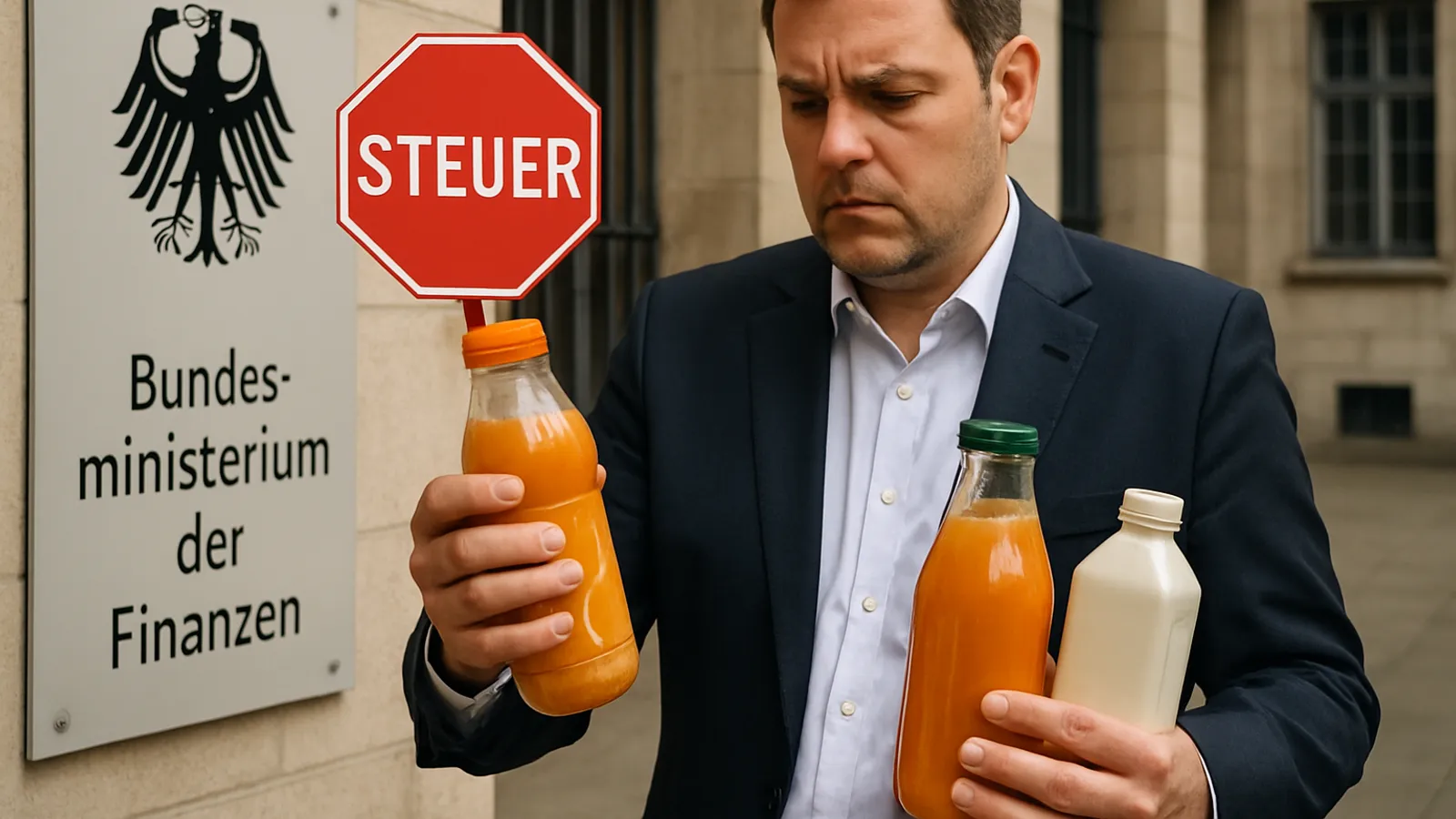
 AI-generated illustrative image · not a real photograph
Germany’s Finance Ministry — Klingbeil wants to expand sugar tax plans to fruit nectar, smoothies and oat milk
Background & Context
The proposal is already more concrete than a general political idea. Germany’s Finance Ministry has presented a policy paper outlining the planned sugar levy.
It would cover not only traditional sugary soft drinks, but also smoothies, fruit nectar, grain-based drinks such as oat milk, and beverages containing added sweeteners. Germany’s finance minister Lars Klingbeil, a Social Democrat (SPD), says the federal government supports the expansion and wants to move it forward.
The Health Ministry also backs the approach. Klingbeil says the main goal is public health, particularly protecting children from excessive sugar consumption.
He argues that raising additional government revenue is not the primary purpose. There has nevertheless been disagreement within the government.
According to Der Spiegel, the Agriculture Ministry objected as recently as August 12 to extending the levy to additional products. It later said it supported the coalition’s agreed plans for a sugar tax as part of the reform of Germany’s statutory health insurance system.
The debate is therefore no longer simply about whether Germany will introduce a sugar tax, but also about how broad it should be. Including oat milk, smoothies and artificially sweetened drinks would significantly expand its scope.
The policy paper is not yet law, however, and both the final design and the products covered could still change.
Article Profile

Dramatization
Low
2/10
The article covers the topic largely soberly, without dramatic exaggeration.
Moralizing
Low
1/10
The presentation largely avoids moral judgments.
Sharpening
Low
2/10
The article is nuanced and avoids confrontational sharpening.
Objectivity
Low
3/10
The presentation is not very factual and strongly evaluative.
Review Transparency
We examined Klingbeil’s statement and reports on the current status of planning at the finance ministry. The planned expansion to nectar, smoothies, and oat milk is documented multiple times.
In addition, consistent reports say there is already a policy paper from the finance ministry that would also cover other beverage categories and drinks with added sweeteners. Klingbeil stated that the federal government supports the expansion.
The Health Ministry also favors the approach. At the same time, it was reported that the Agriculture Ministry had previously raised objections to expanding it to additional products.
It is therefore important to distinguish between a concrete political and ministerial plan and a law already passed. The policy paper shows the planning is further along than a mere political review.
Still open are the final legal design, possible changes during interministerial coordination, and the exact timing of any introduction.
Impact Check
Does it affect you?
60% impact
Germany’s food industry and consumers could be affected, as expanding the sugar tax could lead to price changes and adjustments in consumption.
Security risk?
10% impact
No immediate security risk for Germany, as this is a tax policy measure.
Historic?
75% impact
Sugar taxes have been discussed worldwide for years as a health promotion tool because they can reduce consumption of sugary beverages.
Why is this article's headline most likely true
The statement is true: Lars Klingbeil wants to expand the planned sugar levy to additional beverage categories such as fruit nectar, smoothies and oat milk. This is more than a loose proposal.
Germany’s Finance Ministry has already presented a policy paper covering these products as well as beverages with added sweeteners. Klingbeil also says the federal government supports the expansion.
The plan is not final, however. There have recently been disagreements within the government over its scope, and the policy paper still has to go through the legislative process.
The headline therefore accurately reflects the current situation: There are concrete plans to broaden the levy, but no final law has been adopted yet.
This analysis is based on a journalistic report by deutschlandfunk.de. The rating and context were produced with AI assistance.
AI Transparency
This analysis was produced, structured and editorially reviewed with AI-assisted systems. The rating refers to the specific statement examined and is based on the sources cited. The cover image is an AI-generated symbolic image and is not a documentary photograph of the event described.
Methodology & AI Transparency